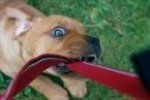
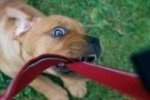
 Some peaces of advice for the owner of the dog.
When dogs deal with other dogs, animals higher on the pecking order may elicit attention from lower ranking animals. Lower ranking animals rarely elicit attention from superiors, but when they do, they also "give" appeasement behaviors (such as groveling on their belly, laying down, licking, etc.) to the higher ranking animal. When combined with many other mixed messages, something as simple as petting your dog whenever he demands without having to give you anything in return may result in your dog believing he ranks higher than you. This in turns leads him to believe that he does not need to respect or listen to you unless it suits him. Thus, when you try to insist, he may react aggressively.
Earning your dog's respect requires you to act in ways that he sees as worthy of respect - and the easiest way to do that is to control resources (the things that matter to him) and only provide them to him when he is cooperating with you. No need to deprive the dog, just the need to have him earn what he wants.

The most powerful tool you have to change your dog's behavior is your attention. DO NOT use any kind of physical correction (grabbing the lead or collar or the dog himself) to force the dog to obey you. Instead, walk away, refusing to acknowledge his existence for a few minutes. Then, in a nice tone of voice, ask again. If it is something the dog really wants, such as his food, playtime, a walk or whatever, you will usually get his cooperation within a few tries. Eventually, this new rule starts to sink in - "The ONLY time you get what you want is when you cooperate."
Reward all positive behavior with praise. When withdrawing attention is not possible, or leads to the dog increasing his objectionable behavior, try putting him outside alone in the yard for a few minutes, or into a room or his crate for a time out. Use a treat if needed to get him outside or into the crate. This does not reward him for disregarding any previous commands, but does reward him for cooperating with your last request of "outside" or "in your crate."
Whenever you find yourself frustrated, give yourself (and the dog!) a break with some time out. Dogs are easily confused by emotions such as anger and fear (their own or yours), so if you lose your calm, sensible approach, avoid further problems and separate yourself and the dog briefly until you feel ready to try again.
Be aware that as you change the rules, the problem behavior may escalate briefly as the dog pushes harder to see what the limits are. It is helpful to write down a daily record of aggressive incidents so that you can begin to see the patterns of frequency (how many times does the behavior occur?) and intensity (how far does the behavior go?). Changes will not occur overnight, but gradually over a period of time. A written record helps during times of frustration. For example, when it seems that nothing is happening at all, the written record may show that in fact, the behavior has decreased from 9 times a day to only 4. This is a significant improvement!
To resolve this behavior problem, you will need to change your own behavior so that your dog can begin to clearly perceive his place in the family structure as the least ranking member, and under the control of all family members, including children. All family members must agree on this program, and be faithful in adhering to it, or you will doom the dog to failure and possible death.
NO FREE LUNCH - Your dog must learn to value your attention, playtime and food. From now on, he will receive nothing from you without giving you something in return such as a sit. For example, if he would like to be petted or have a toy thrown, he must sit promptly on the FIRST command. You may then pet him briefly or throw the toy once or twice. If he fails to sit, ignore him and do not give him any attention or petting for at least 3 minutes. You may then try again.
TEACH SELF CONTROL - See the article on Teaching Self Control as well as our booklet, "Understanding & Teaching Self Control"
PUT ALL TOYS AWAY - Leave one or two toys to chew on and that the dog can play with by himself. Put all other toys away - these will now be the toys that you use to play with the dog. YOU will now choose play time, when it begins, when it ends, and what the rules are. DO play with your dog, but expect him to do something before you throw the toy. If he refuses, quietly get up, put the toy away & ignore him for at least 10 minutes
PUT FOOD UNDER YOUR CONTROL - Free choice feeding is a poor idea for dogs who are not by nature meant to nibble all day. At specific times, you feed your dog, and use this time to make him really work for his meals. Remember, you may be giving him a hundred or more "training opportunities" in each bowl - make him work by sitting for just 2-3 kibble in his bowl at a time.
Have him sit, put 2-3 kibble in his bowl, and insist that he stay sitting until you tell him "OKAY, Eat". If he moves or jumps toward the dish, calmly put it back on the counter for a minute or so, then try again. When he will politely sit and wait, allow him to eat the few kibble, then reach down, take the bowl, move a few feet away, ask him to sit (and WAIT), put the bowl down in the new spot and repeat with a few more kibble. You can work with this all over the house & yard, expecting him to sit and wait politely in all rooms before receiving a few kibble. The 10-15 minutes to "serve" a meal in this fashion is time is well spent.
If he decides he'd rather not eat rather than play by your rules, quietly put the food away and then try again at the next meal. Dogs will not starve themselves. It may take up to 4-5 days before your dog decides that he values his food enough to work with you on your terms. If this seems a little heartless, think hard about the reason this step is necessary - you have allowed your dog to get dangerously out of control, and he has either bitten someone or threatened to. A biting dog is not only a huge legal liability, but sooner or later, may have to be put to sleep. Being firm at this stage could save your dog's life.
CONSIDER CHANGING FOODS - Your dog may not have skin problems, diarrhea, vomiting or other obvious signs of allergies, but in my experience, behavior problems, irritability, poor appetite, excessive stool and/or gas, recurring hot spots or ear infections point to possible food allergies or food intolerances. Many dogs receive far too much protein, which is converted into energy which can be a problem if the dog has no acceptable outlet for that energy. First, evaluate the protein - see if you can lower it by switching to another food. Try a food whose main ingredients are unlike your current dog food. If, for example, your current dog food contains chicken and corn, seek out lamb & rice, turkey & barley, duck & potato, etc. Also read the labels on treats - full of calories, high protein & stuffed with chemicals, sugars, salts & preservatives, many dog treats are not a great addition to your dog's diet.
EXERCISE - A huge percentage of problem dogs do not receive sufficient exercise. Increase your dog's exercise by long walks, jogging, playing in the back yard or whatever he enjoys, and keep it regular and vigorous. Remember - unused energy has to go somewhere, and a tired dog is almost always a good dog.
WHEN IN DOUBT, WALK OUT. Use your dog's natural desire for your attention to work for you. If the dog becomes aggressive when asked to do something, simply withdraw your attention. This may mean you need to go into another room and shut the door for a few minutes. When you re-enter the room, use a treat to call the dog to you, then ask him to sit or lay down, rewarding him for showing you his willingness to work with you. If he does not comply, walk away again.
USE TRAINING EQUIPMENT - Rather than grab a dog who is misbehaving, you are better off leaving a training collar and lead on him while you are with him. (Never on an unattended dog.) If appropriate, quietly pick up the leash and gently reinforce the command. Be calm but firm.
ANTICIPATE PROBLEMS - Knowing what situations may trigger your dog's aggression and his body language changes will allow you to prevent this behavior from occurring. For example, if your dog is aggressive when people enter the house, have him on lead and sitting as they enter, instead of trying to stop him from running around out of control and biting. Whenever possible, help the dog substitute desirable behavior for his problem behavior and PRAISE!
TRAIN - Initially, you may need to work on your dog's behavior and your relationship with your dog in private lessons. Once your dog's basic problems are under control, enroll in a basic obedience class to help your dog become a more enjoyable companion, and improve your overall relationship with your dog. Remember, training is a lifetime process, not a quick fix. The sooner you begin, the more years you will have to truly enjoy your dog.


 to mention what I consider the two main types. In future articles I will explore some of the less well known styles of training, some of which are becoming quite popular. This page and the next two pages should help you decide on the best style of training for your individual pet.